news
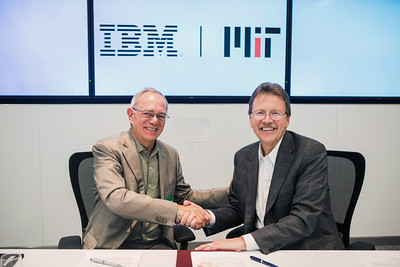
IBM and MIT to pursue joint research in artificial intelligence, establish new MIT-IBM Watson AI Lab
09/07/2017 - MIT News
2017-2026
The MIT-IBM Watson AI Lab helped pioneer a model for academic-industry research collaboration, aligning long-term scientific inquiry with real world impact. Since its inception, the lab has funded over 210 research projects involving over 150 MIT faculty members and over 200 IBM researchers. Collectively the projects have led to over 1,500 peer-reviewed articles and generated 61 patent disclosures. Fifty-four innovations emerging from the lab were put to use by industry members. The lab also helped shape the career growth of a number of MIT students and junior researchers, funding more than 500 students and postdoctoral scholars.
The MIT-IBM Computing Research Lab capitalizes on this foundation, expanding both the scientific scope and the ecosystem of collaborators across the Cambridge-Boston region and beyond.
Explore highlights from the first iteration of the Lab below.
News
IBM and MIT to pursue joint research in artificial intelligence, establish new MIT-IBM Watson AI Lab
09/07/2017 - MIT News

MIT-IBM Watson AI Lab seed to signal: Amplifying early-career faculty impact
03/17/2026 - MIT News
Research
The first iteration of the Lab focused on AI research. AI is a big topic. We find it helpful to modify it with some adjectives: Narrow, Broad, General.
Narrow AI is the ability to perform specific tasks at a super-human rate within various categories, from chess, Jeopardy!, and Go, to voice assistance, debate, language translation, and image classification. Broad AI is next. We’re just entering this frontier, but when it’s fully realized, it will feature AI systems that use and integrate multimodal data streams, learn more efficiently and flexibly, and traverse multiple tasks and domains. Broad AI will have powerful implications for business and society. Finally, General AI is essentially what science fiction has long imagined: AI systems capable of complex reasoning and full autonomy. Some scientists estimate that General AI could be possible sometime around 2050 – which is really little more than guesswork. Others say it will never be possible. For now, we’re focused on leading the next generation of Broad AI technologies for the betterment of business and society.
Here are some of the key technical themes shaping the path to Broad AI.